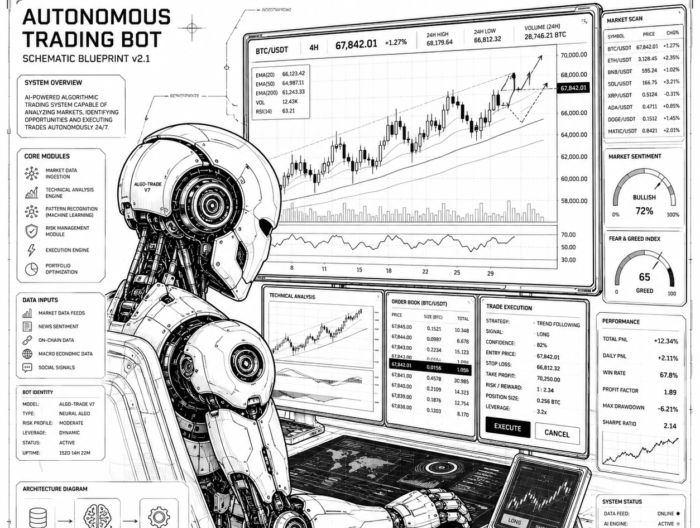
Markets aren’t just a bunch of people staring at charts and smashing buy or sell. I mean we still draw support and resistance, watch candles, chase breakouts, fade pumps, panic close positions, and occasionally revenge‑trade like clowns after one bad stop. But behind the screen, a massive part of the market is already automated.
A lot of the market is machines reacting to other machines while humans build the systems, fund them, and try to keep everything from blowing up. Algorithms route orders. Big trades get sliced into tiny pieces. Market makers quote both sides of the book. Arbitrage systems scan price differences across exchanges. Risk engines adjust exposure on the fly.
That’s why bots dominate.
Most professional bots aren’t sitting there thinking, “Is this a good long?” They’re built to solve specific problems.
Execute large orders.
Provide liquidity.
Hunt price gaps.
Hedge exposure.
Enforce strategy rules.
They all get called “bots,” but they’re not doing the same job.
Execution bots exist so big players can enter or exit without nuking the chart. If an institution wants to buy size, they can’t just market buy into the abyss. That would create slippage, signal intent, and ruin the fill price. So the bot slices the order, spreads it across time, volume, and venues.
Market making bots play a different game. They post bids and asks, capture spreads, manage inventory, widen quotes when volatility spikes, hedge when they’re off‑balance, and yank orders when flow looks dangerous. One trade might make cents but across thousands of markets, those tiny edges add up.
Arbitrage bots chase price differences across exchanges. In crypto, where liquidity is scattered everywhere, this actually matters. On paper, it looks like free money. In reality the fees, slippage, latency, liquidity, and execution risk turn “free money” into pain.
Risk and hedging are essential. They cut exposure when volatility expands, hedge when portfolios drift, and enforce limits automatically. They don’t try to make money they try to keep the system alive.
Then there’s the strategy bot the one retail traders obsess over. The classic “enter here, exit there” bot using MA crosses, RSI, breakouts, funding signals, trend filters, whatever. And yes, these can work but only if the underlying logic has real edge. Automation doesn’t fix a weak strategy it just executes weak logic faster. This is where people misunderstand bots, when they hear “bots dominate” they assume bots are better at predicting price.
A bot can trade all day and make almost nothing or lose money. This is the trap for retail traders. They see big firms using automation and think the answer is simple, build a bot.
But building a bot isn’t the hard part.
A bot that sends orders? Easy.
A bot that follows rules? Easy.
A bot that backtests well? Too easy.
A bot that survives live markets?
That’s the hard part.
Live trading has fees, spreads, slippage, latency, liquidity issues, exchange hiccups, regime shifts, and overfitting landmines. Backtests hide all these but live trading expose them instantly.
AI bots aren’t intelligent by default.
Bad logic + automation = a very efficient mistake machine.
So the real question isn’t, “Should I build a bot?” Its “What useful job will this bot actually do?”
Most traders lose for specific reasons and when they become bot builders they simply automate their flaws. A bot can make a real difference only if the system has a real purpose.